Why Is My Attention Span So Short? (The 47-Second Answer)
Short answer
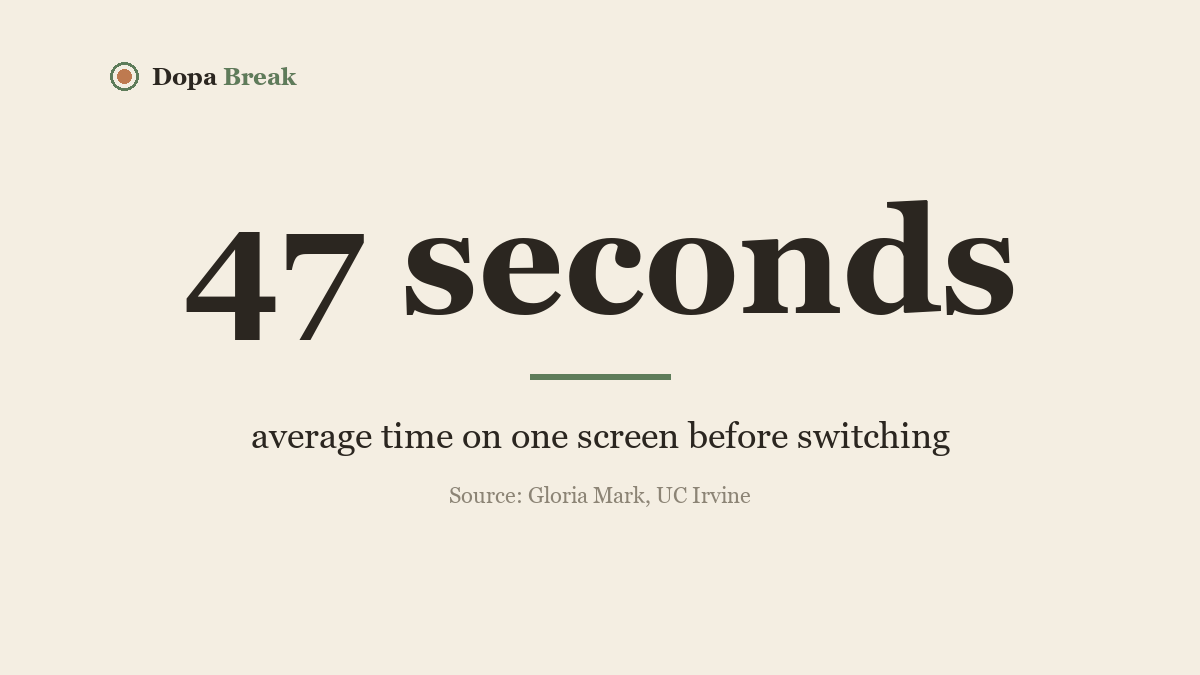
A short attention span is usually a trained switching habit, not a sign of damage. Attention researcher Gloria Mark has logged screen behavior for two decades and found average time on one screen before switching fell from about 2.5 minutes in 2004 to roughly 47 seconds in her recent data. That measures a switching habit shaped by feeds and notifications, and trained habits respond to retraining within weeks.
- Gloria Mark's tracking data shows average time on one screen before switching fell from about 2.5 minutes in 2004 to around 47 seconds recently.
- The figure measures how often people switch screens, not a fixed ceiling on how long anyone can concentrate.
- The viral "8-second, shorter than a goldfish" claim has no real study behind it and should not be taken literally.
- Because the shrinkage is trained by feeds and notifications, cutting novelty and practicing single-tasking can reverse it.
Your attention span is short because your environment trained it that way. Attention researcher Gloria Mark has measured how long people stay on one screen before switching: about 2.5 minutes in 2004, roughly 47 seconds in her recent studies. That is a trained switching habit, not brain damage, and trained habits can be reversed.
How short is the average attention span now?
Gloria Mark, a professor at UC Irvine, has logged real screen behavior for two decades using tracking software rather than surveys. Her team measured an average of about 2.5 minutes on a single screen in 2004, around 75 seconds by 2012, and about 47 seconds in recent years. Importantly, this measures how often we switch, not some fixed capacity of the brain. You can still lose an hour to a film or a game, which proves the capacity is intact.
What actually shrank it?
- Short-form video and feeds. They deliver novelty every few seconds and train your brain to expect a constant stream of new things.
- Notifications. Every ping invites a switch, and every switch leaves residue that lingers into the next task.
- Self-interruption. Mark found people interrupt themselves almost as often as apps interrupt them, purely out of habit.
- Sleep debt and stress. Both reliably reduce sustained attention on their own.
Is the goldfish statistic true?
No. The claim that humans now have an 8-second attention span, shorter than a goldfish, is a marketing myth with no real study behind it. Attention is not one number: it varies enormously with task, interest, rest, and practice. The 47-second figure describes measured switching behavior on screens, which is real, and changeable.
Can I get my attention span back?
Yes. Because the shrinkage is trained, it responds to retraining: fewer novelty hits, short daily single-task practice, and honest rest. Most people notice a difference within a couple of weeks. This progressive, small-reps approach is exactly what Dopa Break structures for you, one short session a day.
Frequently asked questions
Is the 47-second attention span real?
Yes, as a measure of screen switching. Gloria Mark’s tracking studies found people average about 47 seconds on one screen before switching, down from about 2.5 minutes in 2004. It measures behavior, not fixed brain capacity.
Is the 8-second goldfish attention span true?
No. That statistic is a marketing myth with no real study behind it. Attention varies by task and can be retrained.
Did short-form video shrink my attention span?
It is the biggest single driver for most people. Feeds train your brain to expect novelty every few seconds, which makes slower tasks feel harder. Reducing short-form video calms that expectation within days to weeks.
Sources
- Capuano, C. (2023), "Can't Pay Attention? You're Not Alone", University of California Interview with Gloria Mark: average time on one screen fell from about 2.5 minutes in 2004, to 75 seconds in 2012, to about 47 seconds recently.